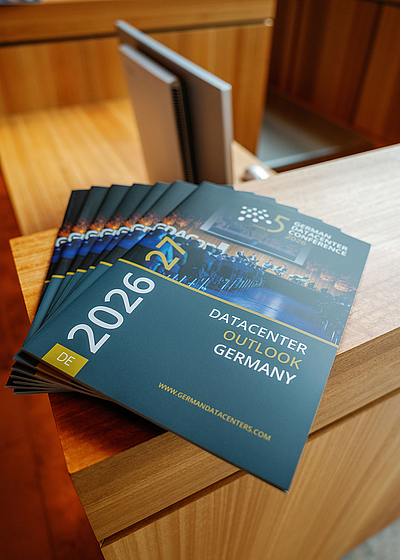


Download Datacenter Outlook Germany 2025/26
Datacenter Outlook Germany 2026/27 [EN]Datacenter Outlook Germany 2026/27
The German data center market is growing—and its future is increasingly being shaped at the local level
The Datacenter Outlook Germany 2026/27 combines current market data with political and regional perspectives on the development of digital infrastructure in Germany. It focuses on network capacities and project readiness, as well as the question of how new data centers can become an integral part of their region.
Market data, policy analysis, and perspectives from the data center ecosystem
Download the Datacenter Outlook Germany 2025 / 26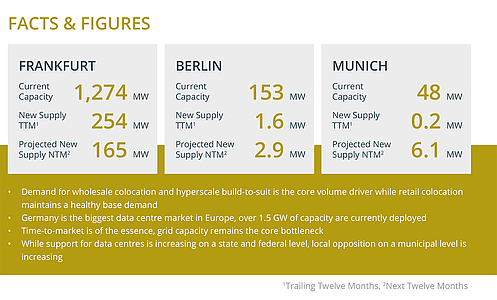
The German Data Center Market 2026/27
Germany remains Europe’s largest data center market. More than 1.5 GW of data center capacity is already in operation. With around 1,274 MW, Frankfurt remains by far the largest German market and accounts for 29 per cent of the total colocation capacity in the FLAPD region. At the same time, new locations are emerging outside the established clusters.
However, market potential alone is no longer the decisive factor in determining whether projects can actually be realised. Grid capacity and time-to-market are becoming crucial location factors. With the new maturity-based procedure for allocating grid connection capacity, greater emphasis is being placed on project maturity, the status of approvals, the technical connection concept and feasibility.
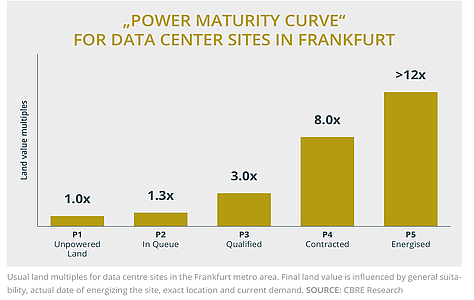
In the Datacenter Outlook Germany 2026/27, CBRE analyses how these changing conditions are affecting site development, land values and the future development of the German market – and what role new efficiency requirements are playing for both existing and new buildings.
All Infrastructure is Local
Why the future of data centres will be decided locally
The National Data Center Strategy has placed the importance of digital infrastructure on the political agenda. However, political objectives only translate into additional capacity once specific projects can actually be implemented.
And each of these projects is based in a specific location.
There, a data center requires space, energy and a network connection. It becomes part of its surroundings and comes up against municipal planning, local interests and legitimate concerns. Planning certainty and local integration are therefore increasingly intertwined.
For us, successful location development begins long before the ground-breaking ceremony: with clear information, open dialogue and a genuine examination of the specific added value a project can bring to the location.
Trust cannot be mandated. But we can work to build it every day.
Martin Kohoutek |Director General of the German Datacenter Association
From Growth to Strategic Development
Wie entwickelt man Europas führenden Rechenzentrumsstandort weiter?
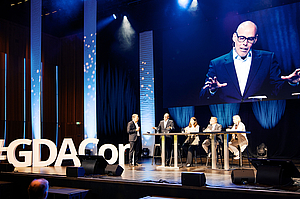
Over the decades, Frankfurt and the Rhine-Main region have grown to become one of Europe’s most important data centre locations. However, as the market expands, so too do the challenges: electricity supply, network expansion, land availability and public acceptance are becoming decisive factors for the next phase of development.
In this interview, Dr Walter Fischedick from the Hessian Ministry for Digitalisation and Innovation discusses how Hesse can continue to develop as a location, why growth is likely to be more spatially differentiated in future, and how a land potential register is intended to provide early guidance to investors and local authorities.
This does not mean turning away from the Frankfurt cluster. Rather, decentralised locations can take on new functions and complement the existing market.
Digital Infrastructure in a Geographically Dispersed State
Which data center models are suitable for Schleswig-Holstein?
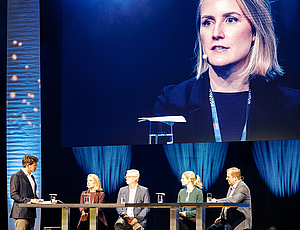
Schleswig-Holstein offers different conditions to the major German data centre clusters: an economic structure dominated by small and medium-sized enterprises, a highly advanced fibre-optic network and a robust energy infrastructure. According to the state government, around 90 per cent of the population has access to a fibre-optic connection.
Julia Carstens, State Secretary at the Ministry for Economic Affairs, Transport, Labour, Technology and Tourism of the State of Schleswig-Holstein, sees this as presenting opportunities for a variety of data centre models – ranging from regionally distributed edge infrastructures to larger sites. Smaller, decentralised data centres in particular can bring computing power closer to businesses and users, whilst at the same time opening up new opportunities for regional value creation and the utilisation of waste heat.
The interview thus offers a different perspective on the development of the German market: not every location has to become the next Frankfurt. Different regions can take on different roles within Germany’s digital infrastructure.
Articles from Datacenter Outlook Germany 2026/27
How are AI, new energy requirements and growing expectations of data centre sites changing the way data centres are planned, built and operated? Companies from the GDA ecosystem shed light on various aspects of this development in the Datacenter Outlook Germany 2026/27.


Growth requires more than just demand
Germany remains a key European data centre market. However, available network capacity, time-to-market and the actual level of maturity of a project are increasingly determining which sites can be developed.

From national strategy to regional reality
Frankfurt/Rhine-Main, Schleswig-Holstein or new locations beyond established clusters: the circumstances vary considerably. The Outlook shows how federal states and local authorities are defining their own roles in the expansion of digital infrastructure.

Digital infrastructure is becoming part of the location ecosystem
Data centres do not operate in isolation. Energy supply, heating networks, land-use planning, the digital economy and local authority interests are all interlinked. This, in turn, is changing the way in which locations are planned and developed.
What will shape the German data centre market in 2026/27?
The Datacenter Outlook Germany 2026/27 combines market analysis, political perspectives and insights from across the entire data centre ecosystem. Insights and assessments from experts in the data centre sector on developments, obstacles and trends, as well as articles on the current political positions of the German Datacenter Association, round off the overall picture.
Download the full Datacenter Outlook Germany 2026/27 as a PDF