
Rethinking data center power for the AI era
Artificial intelligence is changing the amount of power a data center needs and how that power is distributed inside the facility.
High-density GPU systems are pushing rack requirements towards hundreds of kilowatts, with megawatt-scale designs now on the horizon. At those levels, conventional low-voltage distribution becomes harder to scale. Higher currents require more copper, larger conductors and more space for electrical infrastructure. Each additional conversion stage also introduces losses and heat.
These pressures are behind growing interest in 800 VDC distribution. However, the move to 800 VDC will not happen across the entire data center at once. The first and most immediate use case is high-density compute.
800 VDC starts with the GPU rack
Supplying power at a higher voltage reduces the current required to deliver the same amount of power. Within high-density GPU racks, that can reduce the size of the power shelves and associated infrastructure, leaving more space available for compute and helping make megawatt-scale racks practical.
Networking equipment, cooling distribution units and other loads could also benefit from DC distribution over time. Adoption is likely to follow the areas where increasing density creates the strongest case, while equipment, standards and operational experience continue to develop.
For many operators, that points towards a hybrid architecture for some time to come. Existing AC infrastructure can continue to serve conventional loads while 800 VDC is introduced for the highest-density compute.
Rethinking the power chain
Higher-voltage distribution can reduce current, conductor size and conversion losses. Greater gains become possible when the complete power chain is reconsidered around the requirements of AI infrastructure.
A recent joint Trane Technologies and Eaton reference design gives an indication of the potential. By advancing medium-voltage architectures for high-density AI facilities, the design reports combined energy-efficiency gains of up to 15%, copper reductions of up to 80% and installation-cost reductions of up to 30% compared with conventional low-voltage designs.
These figures relate to the complete reference design rather than 800 VDC in isolation. They show the potential available when power conversion, distribution and protection are engineered together from the grid connection through to the rack.
Engineering for a power-sensitive environment
Direct-current distribution is already established in other industries, but data centers bring a particular combination of high power density, sensitivity to power disturbances and demanding availability requirements.
800 VDC distribution therefore requires careful coordination across the electrical system. New technologies such as solid-state transformers and solid-state circuit breakers are being developed for these architectures, with protection, power conversion, energy storage and rack-level equipment all needing to work together.
The relationship with the rack itself is especially important. Protection has to respond quickly enough to isolate faults while avoiding unnecessary disruption to adjacent compute. Decisions made around power shelves and GPU loads can consequently affect equipment and protection strategies much further upstream.
Facility electrical engineers, rack designers and equipment suppliers will need to work more closely as rack densities rise. Power architecture can no longer be developed independently of the compute systems it supports.
Building experience with higher-voltage DC
There are potential advantages to moving to still higher DC voltages as rack and facility power continues to increase. For now, the industry has a substantial amount to learn from deploying 800 VDC safely and reliably at data center scale.
Those deployments will build practical experience in areas including protection, switching, safety, maintenance and system coordination. They will also help operators establish where DC distribution provides the greatest benefit and where conventional AC remains the better fit.
The lessons are already feeding into thinking about the next generation of power architectures. Rather than a single wholesale transition, the path is likely to be a gradual expansion of higher-voltage DC as technologies mature and operational confidence grows.
Preparing Germany’s infrastructure for denser compute
Germany faces the same rapid increase in AI compute density as the wider global market, alongside particularly acute questions around power availability, efficiency and resilient digital infrastructure.
800 VDC cannot address shortages in grid capacity. It can, however, help operators make better use of the power and physical space available within the data center, particularly as GPU racks move towards much higher densities.
Planning for that transition now gives operators more flexibility as AI infrastructure evolves. The immediate focus is the high-density GPU rack, but the engineering experience gained there will influence power distribution across the wider facility. As the data center ecosystem adapts, 800 VDC is likely to become an important part of how new capacity is designed, protected and scaled.
What will shape the German data center market in 2026/27?
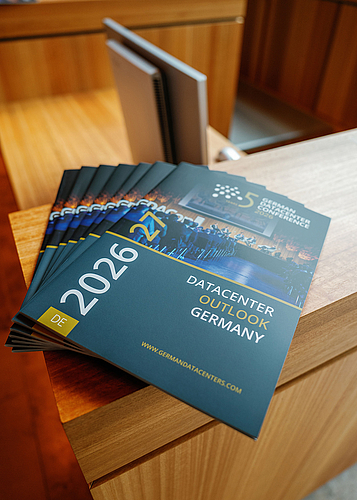
The Datacenter Outlook Germany 2026/27 combines market analysis, political perspectives and insights from across the entire data center ecosystem. Insights and assessments from experts in the data center sector on developments, obstacles and trends, as well as articles on the current political positions of the German Datacenter Association, round off the overall picture.
Download the full Datacenter Outlook Germany 2026/27 as a PDF