

Which Data Center Models Are Right for Schleswig-Holstein?
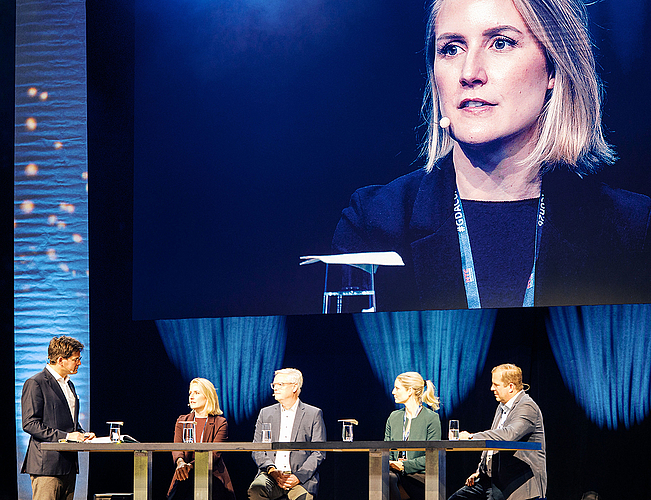
We spoke with Julia Carstens, State Secretary in the Ministry of Economic Affairs, Transport, Employment, Technology and Tourism at State of Schleswig-Holstein.
As a geographically dispersed state, Schleswig-Holstein is structured differently from many of Germany’s major economic and digital hubs. What requirements does this create for a future-proof digital infrastructure – and what opportunities could its expansion offer for the state’s economic and regional development?
State Secretary Julia Carstens: Schleswig-Holstein’s economy is predominantly shaped by small and medium-sized businesses. And small and medium-sized enterprises need good infrastructure, which we have in place. Our state is situated between the North Sea and the Baltic Sea and connects Scandinavia with Central Europe, which means that a central network infrastructure with high-performance backbones is already available. Schleswig-Holstein is also a pioneer in fibre-optic expansion. Around 90 percent of the population has access to a fibre connection, and two thirds of them make use of it. This promotes acceptance of digitalisation and, in turn, acceptance of digital infrastructure.
One building block could be smaller, regionally distributed data centers – for example edge data centers developed by private providers, but also by municipal utilities, municipally owned companies or fibre network providers. Do you see this as a model for Schleswig-Holstein to bring digital services and computing capacity more broadly into the regions?
Yes, we are receiving enquiries for data centers across the state because we are making good progress with network expansion. This applies to both power and data networks. Regionally distributed data centers are important for public acceptance, while proximity to businesses and users is in turn an important factor for attracting further investment. In addition, a regional distribution generally makes it easier to utilise waste heat from data centers. So it is a classic win-win situation. Operators can promote their sustainability credentials, while local communities can benefit from affordable heat. Therefore, regionally distributed data centers are an important building block of our digital infrastructure.
Successful data center locations depend on a combination of different factors: high-performance power and fibre networks, suitable sites, planning certainty and appropriate conditions at municipal level. Where do you see Schleswig-Holstein as already well positioned today – and where does the state still need to create the necessary conditions?
Our state is an ideal location for energy-intensive businesses such as data centers because we generate more than twice as much renewable energy as we consume. As mentioned, we are a pioneer in grid expansion, and grid stability is above the national average. The potential availability of suitable sites is also good as a result of grid expansion and the associated construction of numerous new substations. But there is still room for improvement here. Our aim is to use our state development plan to ensure that provision can explicitly be made for land for energy-intensive businesses in these locations.
Different data center models have different location requirements: edge infrastructure benefits from proximity to businesses and users, while large data centers for AI training are less dependent on traditional internet hubs but place high demands on energy supply and grid capacity. Does this breadth of different models present a particular opportunity for Schleswig-Holstein – and does it require a differentiated approach to attracting investment?
The broad range of different data center models presents a major opportunity for Schleswig-Holstein. From an economic policy perspective, our objective is to make better use of surplus renewable energy locally and thereby increase value creation within the state. The establishment of energy-intensive businesses such as data centers follows the grid expansion undertaken by network operators. This applies to both the distribution grid and the transmission grid. Available connection capacity to the power grid is the decisive factor before other requirements can be met. Network operators such as TenneT and SH Netz provide support in this regard. Initial information on available connection capacities can also be accessed online. As grid expansion continues, new available connection capacities will emerge. Therefore, grid expansion in Schleswig-Holstein is important both for the energy transition and for businesses looking to establish operations in the state.
Digital infrastructure can be more than a location factor for data centers themselves. High-performance fibre networks, regional computing capacity and access to cloud and AI infrastructure can also be attractive for industry, SMEs, research and new business models. How can the state help to create a broader regional digital ecosystem around this infrastructure?
The digital economy has been a focus of Schleswig-Holstein’s investment attraction strategy for many years. The DiWiSH cluster (Digital Economy Schleswig-Holstein), for example, has existed for 20 years. DiWiSH connects the digital sector across the state and promotes the transfer of digital technologies into other areas of the economy. The cluster brings together business, academia, public administration and politics, thereby strengthening Schleswig-Holstein as a digital location. Schleswig-Holstein already has a broadly established digital ecosystem that is also attractive for data centers.
The conditions in Schleswig-Holstein are also optimal when it comes to fibre-optic expansion. Through strong cooperation between the state, municipalities and private-sector stakeholders, we have been implementing a broadband strategy since 2013 that is clearly focused on fibre as its infrastructure objective. Today, fibre networks are available to businesses, academia and citizens in all regions of the state.
Thank you very much for the interview!
What will shape the German data center market in 2026/27?
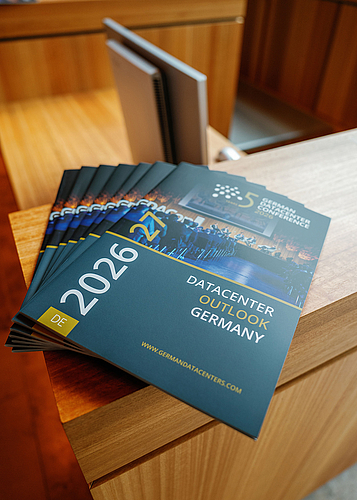
The Datacenter Outlook Germany 2026/27 combines market analysis, political perspectives and insights from across the entire data center ecosystem. Insights and assessments from experts in the data center sector on developments, obstacles and trends, as well as articles on the current political positions of the German Datacenter Association, round off the overall picture.
Download the full Datacenter Outlook Germany 2026/27 as a PDF