
Stable growth in Europe's central market, in an era of transforming business models and changing market conditions
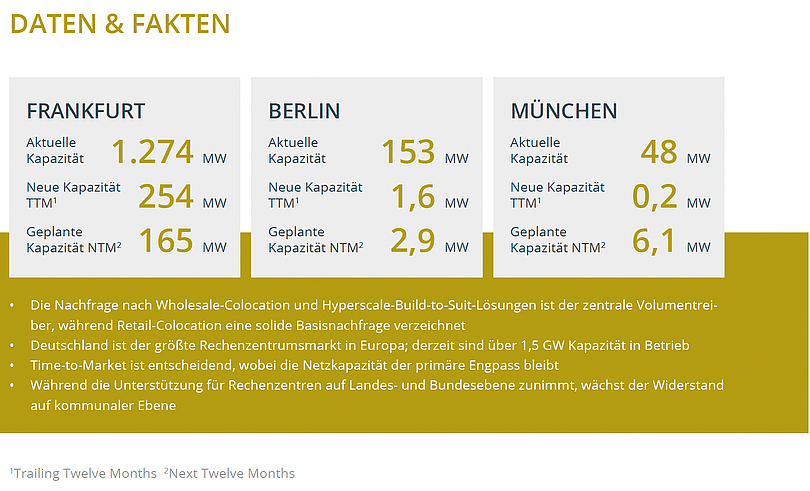
In Q2 2026, total colocation data centre supply in FLAPD reached a record capacity of 4.4GW, a 19% increase since mid last year and a 18.9% CAGR since 2020. Frankfurt and London are the two largest markets with Frankfurt accounting for 29% of FLAPD capacity, by far the biggest market in continental Europe.
Berlin, a distant second to Frankfurt when supply is considered, has stagnated of late when data centre construction is considered. However, it is still the 9th largest colocation market in Europe. Growth potential in Berlin is still high as multiple operators have landbanked sites and announced projects. But while Frankfurt is still the market of greatest interest [KR1] from all hyperscalers and major cloud providers, Berlin (and Munich) only attracted partial data centre commitments that is reflected in lower overall demand. Smaller markets in Germany are set to experience shallow growth due to more localized demand for data centre capacity with AI inference being a strong contributor of this demand. More out-of-market developments are now materializing with Microsoft’s developments in North Rhine-Westphalia [KR2] and the Schwarz Group project in Lübbenau being among the most prominent examples. These projects add sizeable data centre capacity to the market but only have a limited impact and pull-factor for additional data centre projects in the region. These large-scale deployments will remain singular events, but the potential scale is massive.
Land value changes under new power allocation methodology
Germany's data centre market in 2026 presents an apparent contradiction. Operators and investors are inundated with land offers, yet occupiers cannot find capacity and only a limited number of projects are entering the construction phase. Land supply and deliverable capacity have decoupled. A core element of this dynamic is that the binding constraint has moved upstream over the last 12 months. Offering a site costs almost nothing while energizing one now takes multiple years and a capital commitment that is often done at risk. At the end of Q3 2025, Germany's four transmission system operators held over 700 connection applications totalling roughly 270 GW. Although 78% of these applications came from BESS systems, data centres accounted for a relevant portion of the remaining requests, creating a massive backlog of power applications. The result is a market in which land is priced on potential while power is now allocated on evidence.
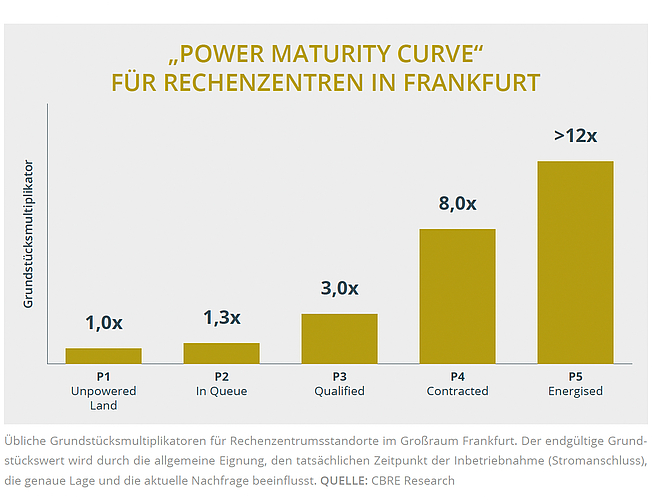
CBRE therefore propose the power maturity curve, a framework that prices a site by its position on a five-step ladder rather than by its location relative to an existing market. P1 is unpowered but zoned land that is generally suitable for data centre development. P2 is a site with an application lodged. P3 is a site that qualifies under the new maturity-based allocation procedure (Reifegradverfahren). With admission fees paid and at least partially meeting the four ranking criteria's set by the TSO. P4 holds an accepted capacity reservation. P5 is energised. The decisive break sits between P2 and P3.
Since 1 April 2026, the TSOs have replaced the first-come-first-served Windhundprinzip with "first ready, first served": applications are pooled in cycles and, where oversubscribed, ranked on four testable criteria, site control and permitting, the technical connection concept, the applicant's capability, and grid and system benefit. Admissibility requires a €50,000 fee and documented minimum standards; an accepted reservation requires a realisation deposit of €1,500 per MW. This changes what land is worth. Under the old regime, an early application conferred priority, so a queue position carried real value. It no longer does for projects that require a direct connection to a TSO. Unsuccessful applications are not rejected but rolled into the next cycle, meaning a P2 site can persist indefinitely, marketed as viable, without ever advancing. Our indicative multiples reflect this: P2 only adds a 1.3 multiplier compared to P1, while P4 and P5 command 8x and above.
About the author
Dr.-Ing. Dirk Turek is Associate Director of Data Centre Research at CBRE. The team provides market intelligence across EMEA, covering all relevant markets, from FLAPD to emerging tertiary markets. The team tracks key metrics such as supply, demand, pipeline, vacancy and pricing, providing unparalleled insights into the data centre ecosystem.
About CBRE
As the world’s largest data center real estate practice, CBRE Data Center Solutions provides the strategies, insights and end-to end services needed to optimize data center solutions from inception through disposition. With an unparalleled understanding of the market, CBRE leverages its extensive global footprint and deep industry expertise to deliver tailored solutions that meet the unique needs of clients across the globe. The Data Centre Solutions team has covered the market for over 25 years, amassing unparalleled expertise in this distinctive asset class.
What will shape the German data centre market in 2026/27?
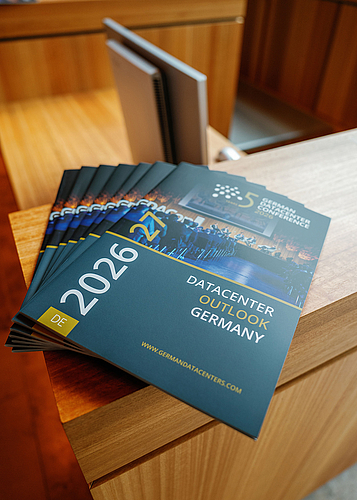
The Datacenter Outlook Germany 2026/27 combines market analysis, political perspectives and insights from across the entire data centre ecosystem. Insights and assessments from experts in the data centre sector on developments, obstacles and trends, as well as articles on the current political positions of the German Datacenter Association, round off the overall picture.
Download the full Datacenter Outlook Germany 2026/27 as a PDF