
What a retrofit entails – and why it becomes necessary
Emergency power systems are generally designed for a service life of 12 years for uninterruptible power supplies (UPS) and up to a maximum of 30 years for emergency power generators (EPG). As they age, the risk of failure increases, spare parts become scarcer and the technology often no longer complies with current regulations or meets the increased performance requirements of a business. A retrofit provides a solution here: this refers to the targeted replacement or comprehensive modernisation of existing emergency power technology – for example, emergency power systems (EPS), uninterruptible power supplies (UPS) and the associated electrical and building management systems – within the existing infrastructure.
The particular challenge here is that, unlike in a new-build project, there is no ‘empty building’ available. The replacement takes place whilst operations are ongoing, i.e. whilst the system continues to run and the areas it supplies – such as a data centre, a production facility or a critical infrastructure operation – must be supplied with uninterrupted power. A shutdown or even a brief interruption to the power supply during the construction phase is usually out of the question in such environments.
Which trades are involved in a retrofit
An emergency power retrofit is rarely a purely electrical installation, but rather an interdisciplinary construction project requiring the coordination of several trades. The process often begins with the structural framework, such as mounting frames, platforms and brackets. These must be designed to support the new equipment, installed and protected against corrosion before the actual systems can be put in place. Furthermore, structural alterations are often necessary – such as adjustments to existing raised floor systems or other technical and functional changes – to ensure the new system integrates seamlessly into the existing infrastructure.
Once the structural work is complete, the actual installation or reuse of existing components takes place: cable support systems are fitted, and the electrical cabling is either replaced or reused. This is followed by the replacement of the main components with a modern, resource-efficient emergency power system and a highly efficient, uninterruptible power supply. To ensure that the new systems can be monitored and controlled, the building management system (BMS) must also be adapted – for example, through additional bus connections, potential-free signals and updated visualisation within the control system. In addition, the existing monitoring technology, such as fire alarm or access control systems, is usually adapted to the new infrastructure to ensure that safety standards are maintained throughout.
The scope of work usually also includes refurbishment: surfaces are restored, for example through filling and painting work. The process concludes with a final clean of all affected areas, from floors to windows, so that the premises are ready for handover not only technically but also in terms of their physical condition.
Because so many trades are interlinked, a precise construction schedule is crucial. Each construction phase must be timed so that the existing emergency power supply is not interrupted at any point – this often means operating redundant systems in parallel whilst
individual components are replaced one after the other. In practice, such projects are therefore often organised as a general contractor arrangement, in which a single point of contact coordinates all trades, rather than the operator having to manage a large number of individual specialist firms themselves.
A real-world example: for a company in Hamburg, two site distribution centres were newly installed, with a scope of work ranging from concrete stations, emergency power generators, UPS systems with batteries and air-conditioning systems to fire alarm, access control and fire-extinguishing systems. Such a project exemplifies how many specialist disciplines must work together in a retrofit project to ensure that the end result is a fully functional emergency power supply that complies with standards.
A secure power supply in uncertain times
There is a clear reason why companies invest in such projects at all: security of supply has become a key strategic issue. Whether it be grid fluctuations, geopolitical risks or statutory safety standards – dependence on the public electricity grid has become a potential weak point in many sectors. One solution to this is controlled independence, achieved through the interplay of uninterruptible power supplies (UPS), emergency power systems (EPS) and battery storage.
In the event of a power cut or voltage fluctuations, the UPS immediately takes over the supply to sensitive loads without any delay – which is crucial, for example, in data centres and server rooms, where even a brief drop in voltage can lead to data loss. It bridges the gap until an emergency power generator takes over power generation. If the UPS cannot provide sufficient backup, emergency power generators come into play: diesel or synthetic fuel-powered generators capable of independently meeting a business’s energy requirements – ranging from manually operated units to fully automated systems that automatically detect power cuts and start up within seconds.
Working in tandem, the UPS bridges the first few minutes, whilst the emergency power system takes over immediately afterwards; as soon as the public grid is available again, the switchover back to the grid takes place automatically. This system is increasingly being supplemented by battery storage systems, which act as buffers and active energy managers and also enable cost-effective temporary storage. More and more companies are even going a step further and exploring the possibilities of fully off-grid operation, decoupled from the public grid.
A retrofit is therefore not only a technical necessity, as old systems are reaching the end of their service life, but also an opportunity: when replacing them, the emergency power supply can be adapted to meet today’s requirements – higher power densities, new regulatory requirements or the integration of battery storage and renewable energy sources. In this way, a necessary upgrade becomes a strategic investment in a company’s future resilience. This is achieved whilst simultaneously increasing efficiency, significantly reducing operating costs and improving the carbon footprint.
About the author
Jörg Böhme has been CEO of Notstromtechnik-Clasen GmbH since 2019, a systems integrator specialising in manufacturer-independent, high-availability emergency power systems. “We equip companies with reliable emergency power so that they can operate with peace of mind and independence” – this is the guiding principle of the company, which, since 1996, has been ensuring that customers – particularly those in critical infrastructure sectors – receive the best possible, needs-based energy supply in emergencies, from design and planning through to installation and maintenance.
About the company
Notstromtechnik-Clasen GmbH (NTC) has been a leading systems integrator in the field of emergency power design and installation for over 30 years. As a manufacturer-independent company, we specialise in integrating bespoke emergency power solutions into existing infrastructure, as well as implementing complete power supply systems in accordance with individual customer requirements and statutory and infrastructural specifications. Our extensive experience ranges from early server room installations in the late 1990s to state-of-the-art data centres of all sizes – including projects with a capacity of up to 300 MW.
A key factor in our success lies in the manufacturer-neutral consultancy, planning, implementation and support we provide for in-house power supply solutions, including retrofits. NTC develops bespoke concepts that are precisely tailored to our customers’ technical, economic and operational requirements – regardless of whether existing systems are being expanded or new facilities are being built from scratch.
What will shape the German data centre market in 2026/27?
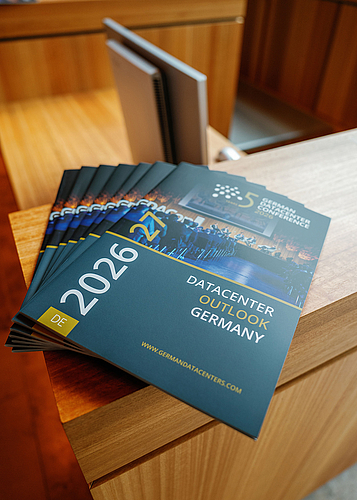
The Datacenter Outlook Germany 2026/27 combines market analysis, political perspectives and insights from across the entire data centre ecosystem. Insights and assessments from experts in the data centre sector on developments, obstacles and trends, as well as articles on the current political positions of the German Datacenter Association, round off the overall picture.
Download the full Datacenter Outlook Germany 2026/27 as a PDF